What's in the Ground Is in the Bottle: How Georgia's Red Clay Makes Aromatics Hit Different
If you've ever driven through the Georgia Piedmont in early summer and caught a whiff of something wild and green coming up from the roadside, you already know there's something different happening here. That smell — that particular richness — isn't an accident. It's chemistry. And a lot of it starts about six inches underground, in the rust-colored clay that stains every pair of white sneakers that dares to touch Georgia soil.
We talk a lot about terroir when it comes to wine, but the same principle applies to every aromatic plant that pulls nutrients from the earth beneath it. The soil doesn't just feed a plant — it shapes it. And Georgia's red clay, as stubborn and unforgiving as it can be to work with, turns out to be an extraordinary medium for producing botanicals with unusually high concentrations of essential oils and bioactive compounds.
What Makes Georgia Red Clay Different
That distinctive brick-red color comes from iron oxide — the same compound that makes rust. Georgia's Piedmont region sits on some of the oldest exposed rock in North America, and centuries of weathering have broken it down into a clay-heavy soil dense with iron, aluminum, and a complex mix of trace minerals including manganese, magnesium, and zinc.
These minerals aren't just background noise. They're active participants in plant metabolism. "When a plant has access to the right mineral balance, it produces secondary metabolites — things like terpenes, phenols, and flavonoids — at much higher rates," explains Dr. Lena Hargrove, a soil ecologist based in Athens who has spent the last decade studying the relationship between Southeastern soil composition and medicinal plant chemistry. "Iron and manganese in particular are co-factors in enzyme systems that drive essential oil production. Georgia clay has both in abundance."
In other words, the same stuff that makes your driveway look like it's bleeding after a rainstorm is quietly turbocharging the lavender, rosemary, and native bergamot growing nearby.
pH, Stress, and the Aromatic Sweet Spot
Georgia's red clay tends to run on the acidic side, typically landing between 5.0 and 6.5 on the pH scale. That acidity is often cited as a challenge for growers — and it can be, for crops that prefer neutral or alkaline conditions. But for many aromatic and medicinal plants, that slight stress is actually a feature, not a bug.
Plants under mild environmental pressure don't just survive — they adapt. And one of the primary ways they do that is by ramping up production of the very compounds that make them useful to us. Terpenes, the molecular building blocks of essential oils, function partly as a plant's chemical defense system. A little adversity pushes the plant to produce more of them.
"Think of it like exercise," says Marcus Tillman, a third-generation herb grower outside Milledgeville who supplies several Georgia-based essential oil producers. "You don't build muscle lying on the couch. These plants are working a little harder in our clay, and what comes out is more concentrated, more complex. When I send samples to the lab, the terpene counts on my Georgia-grown plants consistently come in higher than what I see from the same species grown in loamy soils up north."
Marcus grows everything from lemon balm and tulsi to native bee balm and yarrow, and he's been tracking his soil chemistry for years. His records show a consistent correlation between the iron-rich pockets of his property and the highest-yielding aromatic harvests.
The Underground Network Nobody Talks About Enough
Mineral content and pH are only part of the story. Beneath the surface of healthy Georgia farmland lives an entire ecosystem of bacteria, fungi, and microorganisms that influence plant chemistry in ways scientists are still working to fully understand.
Mycorrhizal fungi, for example, form symbiotic relationships with plant root systems, dramatically expanding a plant's ability to absorb water and nutrients. Research has shown that plants with robust mycorrhizal networks don't just grow bigger — they produce higher concentrations of secondary metabolites, including the aromatic compounds we extract as essential oils.
Georgia's clay soils, when managed with organic practices and minimal tillage, support rich microbial communities. Growers who avoid synthetic fertilizers and let their soil breathe report not just better yields, but noticeably more fragrant harvests. "I stopped tilling hard about five years ago," Marcus says, "and within two seasons, my bee balm smelled like a completely different plant. More intense. More layered. The bees noticed before I did."
Dr. Hargrove agrees that the microbial dimension is often underestimated. "We're learning that the soil microbiome communicates with plant root systems in ways that directly influence which genes get expressed. That includes the genes responsible for producing essential oil compounds. Healthy soil biology means more complex, more potent aromatics."
What This Means When You Open the Bottle
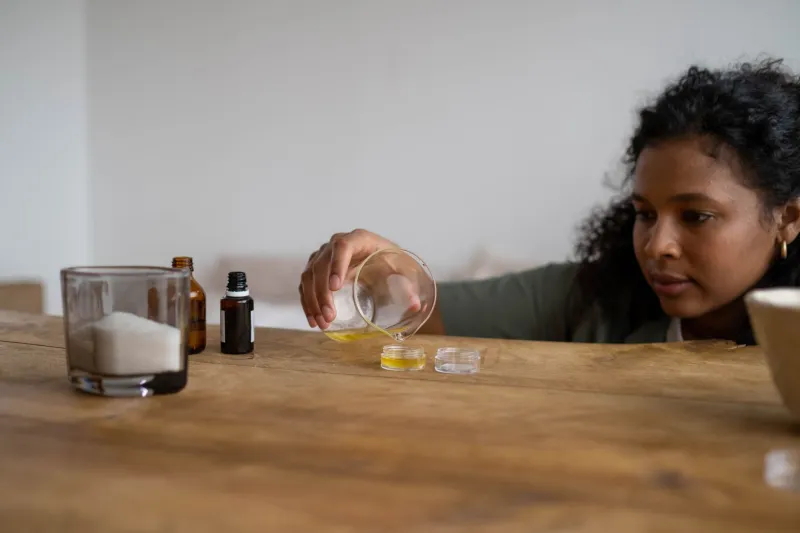
For anyone who uses essential oils or aromatic herbs for wellness — whether that's diffusing, cooking, making tinctures, or crafting homemade salves — all of this science has real, practical implications.
A bottle of Georgia-grown essential oil isn't just a regional novelty. It's a product shaped by specific geological conditions that have been building for millennia. The iron in the clay, the acidity of the soil, the microbial networks threading through every acre — all of it shows up in the chemistry of the final product in ways that generic, mass-produced imports simply can't replicate.
This is part of why so many small-batch Georgia producers are starting to include soil data and growing region information on their labels. Transparency about terroir matters. A bergamot mint grown in Georgia red clay isn't the same plant as one grown in California's Central Valley or shipped in from Eastern Europe. The molecules tell a different story.
Keeping the Soil Alive
Of course, none of this happens automatically. Red clay can become compacted and lifeless if it's mismanaged — stripped of organic matter, drenched in synthetic inputs, or plowed into submission. The growers producing the most potent aromatics in Georgia are the ones treating their soil as the living system it is.
Cover cropping, composting, reduced tillage, and thoughtful crop rotation all play a role in maintaining the microbial diversity and mineral availability that make Georgia clay so productive for aromatic plants. It's a relationship, and like most relationships, it requires attention.
For those of us who buy local, support Georgia-grown botanical products, or tend our own backyard herb gardens, understanding that relationship changes how we think about what's in the bottle — or the bundle, or the tea. The scent that hits you when you open a jar of Georgia-grown lavender isn't just pleasant. It's the story of the ground it came from, written in terpenes and phenols and the quiet chemistry of red clay doing what it's been doing for centuries.
And that, honestly, is worth paying attention to.